Sonntag, 1. April 2007

useful websites


My dear fellow students I must confess that this week I wasn't actively on the look-out for new websites. Please don't skin me alive; it's just that I came home and the weather is brilliant (the sun, as pictured above, is smilling at me).
However, I did find one useful site quite accidentaly. It is the "free dictionary" which offers legal, medical, financial dictionaries, a thesaurus and a dictionary of idioms. Have a merry time browsing it:

personal finance- part 1


The next topic in my "everyday English" series is personal finance, so that you don't find yourself lost for words about money and transactions if you were to live or stay in an English speaking country.

Sam has gone to the bank with his friend Jim to get a statement.


Sam: Oh, Christ! No! I'm overdrawn again. Do you know how much they charge? Sixteen per cent!


Jim: Haven't you got an overdraft?


Sam: I had one last year for a while. But the next one will knock me back 25 quid. And that's just the arrangement fee.


Jim: Well, shall I lend you something?


Sam: No, it's OK, thanks. The joke is that I've got money in a savings account, but I cannot get at it.


Jim: That's not much help, is it?


Sam: Well, you cannot do partial withdrawals. You know, just the whole lot. But the interest rate's brilliant.


Jim: So what are you going to do now?


Sam: I don't know. I'll think of something.


Explanations:
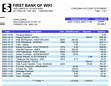

bank statement-a printed record of the money put into and removed from a bank account

be overdrawn; overdraw-having taken more money out of your bank account than the account contained, or (of a bank account) having had more money taken from it than was originally in it:

They were overdrawn by £150, so they couldn't write any cheques.

overdraft-an amount of money that a customer with a bank account is temporarily allowed to owe to the bank, or the agreement which allows this:to run up/pay off an overdraft

knock someone back-informal-cost someone a lot of money

quid- informal- pound or pounds

savings account-an account in a bank or similar financial organization which earns interest

p.s. You can withdraw money at any time from a current account, but not from a savings account.

famous people


"She doesn't give a shit what people say about her as long as they say it", someone once wrote about the Greek-born author Arianna Huffington.


At the moment, though, she is the one who is doing the talking. Her political blog The Huffington Post (http://www.huffingtonpost.com/) set up in May 2005, is one of the most influential in America.

Born Arianna Stassinopoulos on 15 July 1950 in Athens, Huffington says she was a shy youngster. This did not stop her studying in Cambridge, however, even though she spoke little English.


In 1974, Huffington wrote the first of 11 books, The Female Woman, on the role of women in society. Six years later she moved to the US.


Within a few months, using what Vanity Fair calls her "dazzling intelligence", she began calling Henry Kissinger and the Reagans her friends. She later met and married millionaire Michael Huffington (picture left), with whom she has two daughters.

When her husband ran as a Republican for a seat in the US House of Representatives in 1992, she supported him. In the late 1990s, however, she switched her loyalties to the Democrats.

In 2003, she campaigned against Republican Arnold Schwarzenegger for the post of governor in California.

jokes


What travels around the world and stays in a corner?
A stamp.
Why wouldn't Cinderella be good at sports?
She lost her shoe, she ran away from the ball, and her coach was a pumpkin.
Are mosquitoes religious?
Yes. First they sing over you, and then they prey on you.

an idiom a week

This week I have a "tasty" idiom for you:


to be the apple of someone's eye


meaning:


If someone is the apple of your eye, you think he/she is very important to you, and you love him/her very much.This idiom is used especially when someone is loved by an older member of his/her family.

what they said


"Life is like a taxi. The meter just keeps ticking whether you are getting somewhere or just standing still." Lou Erickso
"Do not dwell in the past, do not dream of the future, concentrate the mind on the present moment." Buddha
"Expecting life to treat you well because you are a good person is like expecting an angry bull not to charge because you are a vegetarian." Shari R. Barr
" Difficult times have helped me to understand better than before, how infinitely rich and beautiful life is in every way, and that so many things that one goes worrying about are of no importance whatsoever..." Isak Dinesen

back to basics


Today's portion of grammar is all about the English "own."
Let me first ask you this (don't be so extremely lazy and look at the answers below before you've tried):
How would you translate these sentences into English?
Es ist schon, ein eigenes Haus zu haben.
Die eigenen Ziele sind manchmal unrealistisch.
The translations below contain a classic mistake made by German speakers:
It is nice to have an own house.
The own goals are sometimes unrealistic.
The correct version is:
It's nice to have one's own home.
One's own goals are sometimes unrealistic.
The problem is that the English adjective "own"- unlike the German "eigen"- can be used only after a possessive word, like my own car etc
If it is not clear to whom the sentence is referring, the word one's is used.
Note that "own" can also be used without a following noun in the construction "a.... of one's own":
We'd love to have a house of our own.
There is just one case in which "own" is used with "an" and "the". It is with the collocation an/the own goal:
Damn! I think I just shot the own goal of the month.